Car accidents are an everyday reality in the United States with nearly 6 million reported car accidents every year. This is especially true in our home state of Utah where roads can be particularly dangerous. With loads of traffic on our busy highways and mountain roads car accidents occur every 8.8 minutes according to the Utah Department of Public Safety.
With how often car accidents occur it is likely that you may end up in an accident, and you may walk away from your crash thinking you’re “fine”. You may not have had any blood, broken bones, and no obvious damage, but that does not mean you have come out unscathed. Days or even weeks after the accident the real pain begins: relentless neck stiffness, pounding headaches, back pain that radiates down your leg, or even anxiety that could keep you up at night.
This is what we in the industry call “invisible” or “delayed-onset” injuries. These are injuries that do not show up at first glance, an X-ray may miss the injury initially, and insurance adjusters love to downplay them because there’s no dramatic photo of a cast or a scar. These injuries are not minor, and are actually some of the most common and life-altering injuries that a person can suffer from. At LifeLaw Trial Lawyers, we have helped hundreds of clients recover from these exact conditions. We believe it is critical that every driver knows the reality of these injuries, and in this article our Salt Lake City car accident attorneys will be explaining exactly that.
1. Whiplash and Soft-Tissue Injuries
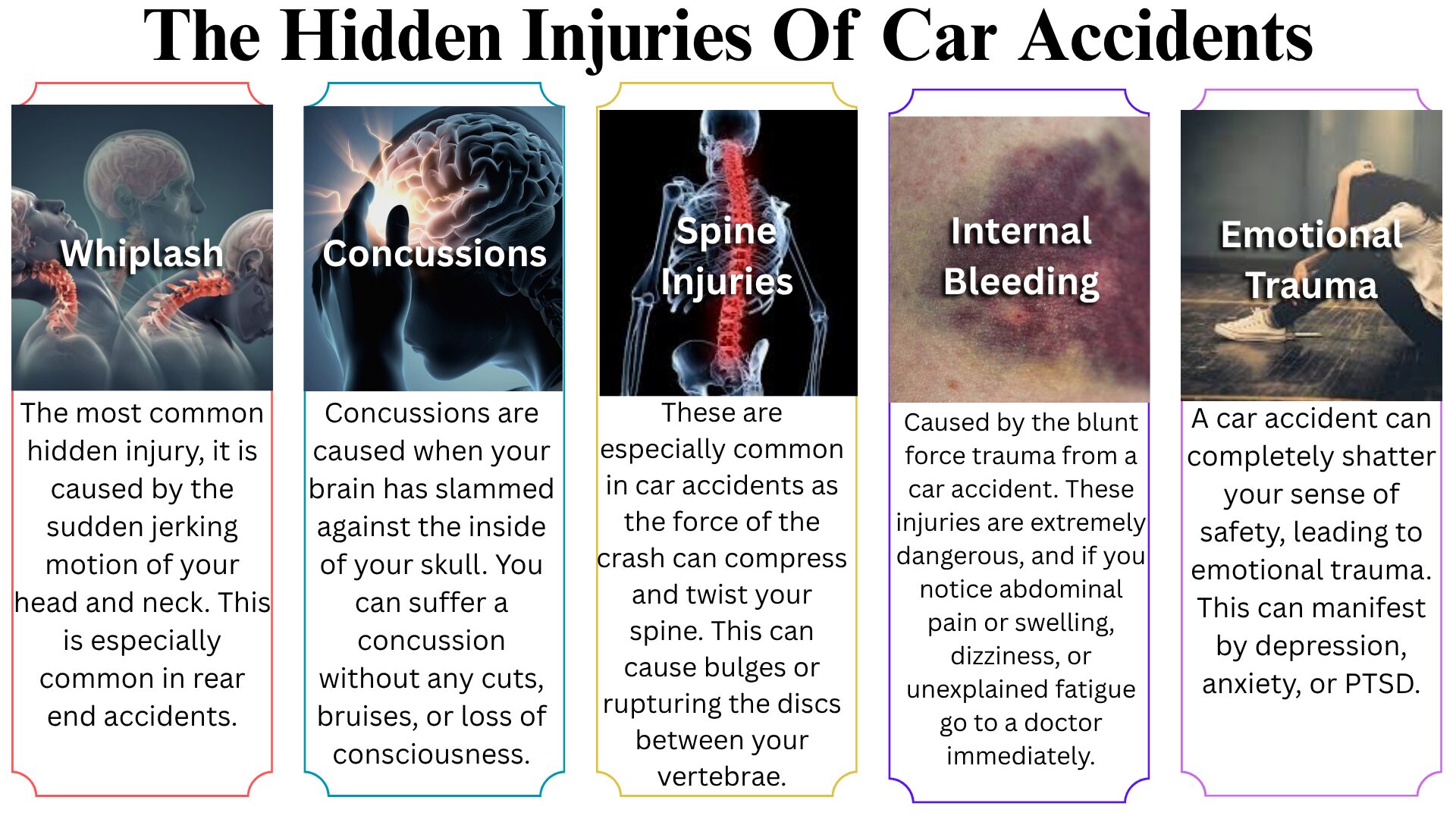
Whiplash is the number one hidden injury in car accidents, especially in a rear end collision. Whiplash is caused by the sudden jerking motion of your head and neck. This then causes tears of the muscles, ligaments, and tendons in your neck and cervical spine.
Why it Stays Hidden: Adrenaline masks the pain of a car accident for 24-72 hours. This means that you may feel fine at the scene of the accident, and even for days after, only to wake up the next morning unable to turn your head.
Common Symptoms Include:
- Neck Pain and Stiffness
- Headaches (often starting at the base of the skull)
- Shoulder or Upper-back pain
- Dizziness or Blurred Vision
- Tingling in the Arms or Hands
Long Term Risks if Untreated: Chronic pain, a reduced range of motion, degenerative disc disease, and even facet joint arthritis. Many victims who suffer from these injuries may suffer for months or years without proper treatment. Soft tissue injuries (sprains, strains, and tears in muscles, ligaments, and tendons) follow the same pattern and are frequently caused by seatbelts or airbags.
2. Concussions and Traumatic Brain Injuries (TBI)
Even in a low speed crash your brain can be slammed against the inside of your skull. No cuts, no bruises, and no loss of consciousness required.
Why it Stays Hidden: Mild concussions often have delayed symptoms. You might feel “off” after your accident and blame it on stress or fatigue, but if you are experiencing these symptoms it is important to get checked out.
Common Symptoms (may appear hours to days later):
- Persistent headaches or pressure in the head
- Dizziness, nausea, or sensitivity to light / noise
- Confusion, memory problems, or “brain fog”
- Mood swings, irritability, or depression
- Sleep disturbances
Long-term effects: An untreated TBI is incredibly serious and can cause long lasting cognitive issues. You may experience chronic migraines, personality changes, and increased risk of depression or anxiety. In more severe cases, these side effects can directly impact your ability to work and enjoy your day to day life. If you have suffered from a TBI contact a Salt Lake City car accident attorney as soon as possible.
3. Spinal and Back Injuries (Herniated Discs, Pinched Nerves)
The force of a crash compresses or twists your spine, bulging or rupturing the soft discs between vertebrae. Lower-back pain is especially common after any car accident.
Why it Stays Hidden: Initial X-rays or CT scans may look normal and not showcase your injuries. Inflammation and nerve compression on your spine builds gradually so an early CT scan may not catch this injury.
Common Symptoms:
- Lower or mid-back pain that worsens with movement
- Radiating pain, numbness, or weakness in your legs or arms (sciatica)
- Muscle spasms or stiffness
- Difficulty sitting, standing, or walking
Long-Term Effects: You may experience chronic pain, permanent nerve damage, limited mobility, and potentially the need for surgery or ongoing physical therapy. We have seen it first hand where many of our clients are unable to perform the physical labor that their jobs require before the car crash.
4. Internal Bleeding and Organ Damage
Blunt force trauma can bruise or rupture internal organs (your spleen, liver, or kidneys) or they may cause internal bleeding. These injuries lie under the surface and can sometimes show no external bruising at all.
Why it Stays Hidden: The symptoms of these injuries can take hours or days to appear, and in the meantime your body might just feel “sore”. If you notice these symptoms we urge you to go to a doctor immediately.
Common Symptoms:
- Abdominal pain or swelling
- Dizziness, fainting, or rapid heartbeat
- Unexplained fatigue or pale skin
These injuries are medical emergencies. If you are feeling any of these symptoms it is absolutely crucial that you go to a doctor. A diagnosis via an ultrasound or CT scan can be life-saving if you are not aware of these injuries.
5. Psychological and Emotional Trauma
Car accidents don’t just injure the body, they can completely shatter the sense of safety that you have. You may experience post traumatic stress disorder (PTSD), anxiety, depression, and fear of driving are very real, compensable injuries here in Utah.
Common Symptoms:
- Flashbacks or nightmares about the crash
- Avoidance of driving or highways
- Panic attacks, irritability, or social withdrawal
- Difficulty concentrating or sleeping
Psychological and emotional trauma develops over time. It may not be immediate but these symptoms may develop over time. If you are feeling panicked or are having flashbacks to your car accident you are not crazy and you should consider talking to a licensed therapist to discuss these issues.
What You Should Do Right Now
- Seek out medical attention immediately after a car accident even if you feel okay. Go to a doctor immediately and let them know that you were in a car accident. The doctor or medical provider will start testing you to see what injuries you may be suffering from.
- Follow through with every recommended test, treatment, therapy, and special visit that your medical professionals recommend.
- Keep a daily journal that tracks your pain levels, the activities you are not able to do, and the emotional impact that your accident has had on you.
- Do not give a recorded statement to the at fault driver’s insurance company without first talking with a Salt Lake City car accident attorney. They will be able to establish your case and begin their fight for you.
- Contact an experienced Salt Lake City car accident attorney who understands how to prove hidden injuries to skeptical insurers and juries.
At LifeLaw Trial Lawyers we work with medical experts, accident reconstructionists, and life-care planners to build ironclad cases for clients with whiplash, concussions, herniated discs, and the invisible scars that no one else can see. We will fight for you to get the compensation that you deserve so you can focus on your health, not on paperwork and insurance battles.
Do not let a hidden injury become a lifelong burden. If you or someone you know has been in a car accident here in Utah, give us a call today for a one hundred percent free consultation. We will review your case, explain your options, and help you take the first steps forward to your full recovery. Your health and your future matter. Let us handle the rest.
Infographic