If you have been injured by the negligence of someone else you may pursue a personal injury claim for the injuries that you have received. During this process you will enter into negotiations for your claim, and if these negotiations fail you may be taking your personal injury claim to the courtroom. Taking your case to court is a serious ordeal, and a trial represents the culmination of efforts to seek justice and compensation for anyone who has suffered harm due to the negligence or wrongful actions of others.
At LifeLaw Trial Attorneys, our Salt Lake City courtroom attorneys have taken our clients cases to trial, where a jury plays a pivotal role. A personal injury trial can be complicated, and the role of a jury can often be misunderstood when your case is headed to trial. In this article our courtroom attorneys will be explaining the role of the jury in a personal injury trial, and how exactly they can affect your personal injury case.
Understanding the Jury’s Role in a Personal Injury Trial
A jury in a personal injury trial consists of ordinary citizens selected from the community to serve as impartial fact finders and decision makers for your case. A typical jury for a personal injury case is comprised of six to twelve members, but this can depend on jurisdictional requirements.
The jury’s primary function for your case is to evaluate all of the evidence from both the defendant and the plaintiff and then render a verdict based on the evidence provided. The jury will decide who was at fault for the accident you have been in, the percentage of liability for the accident, and the compensation that you will be awarded for your injuries. They are the final deciding factor for your personal injury case.
Jury Selection
The process for the jury begins with jury selection. In this stage potential jurors are brought into the courtroom and questioned by both the plaintiff and defendant’s attorneys, as well as the judge. In this stage the objective is to identify and exclude any individuals who may seem to harbor specific biases, preconceptions, or conflicts of interest that could potentially compromise their ability to be impartial for your case.
For example, a juror who has a history of similar injuries or afflictions with insurance companies may be challenged to see things impartially, leading them to be excluded from the jury. Once the defense and your courtroom attorneys have selected the jury, the jury is sworn in to uphold their duty to decide the case solely on the evidence and applicable law.
Evaluating Evidence and Testimony
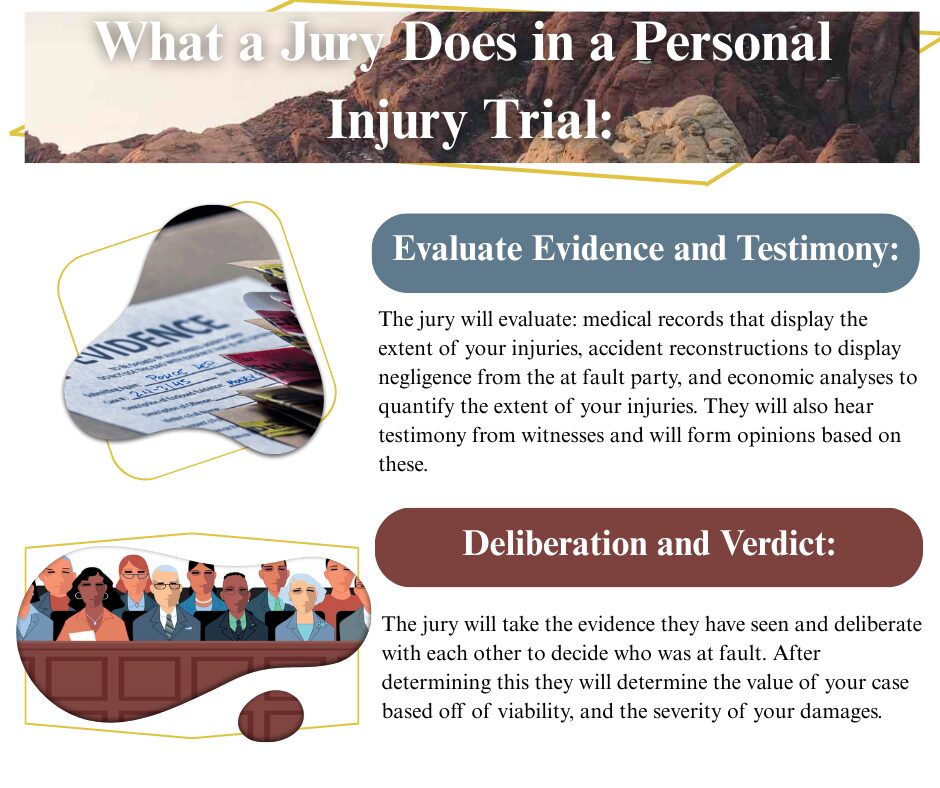
Throughout the trial, the jury will attentively observe the presentation of evidence, including witness testimonies, expert opinions, documents, photographs, and physical exhibits. In a personal injury case, this evidence that will be examined is typically:
- Medical records that display the extent of the injuries that you have received
- Accident reconstructions that recreate the scene of the accident to display the negligence of the at fault party
- Economic analyses quantifying the amount of wages that you have lost as well as any future medical expenses from your injuries
The jury will also assess the credibility of the witnesses that are called to the stand. These witnesses can include you (the plaintiff), the defendant, doctors who have provided treatment, and any experts that were used to strengthen your case. The jury will weigh the credibility of these witnesses through several factors such as consistency, demeanor, and supporting documentation. The jury’s job will distinguish between factual evidence and legal arguments, adhering strictly to the judge’s instructions on what constitutes admissible information.
Deliberation and Verdict
After both sides have presented their cases and delivered their closing arguments, the jury will be taken to a private deliberation room. In this room the group of jurors will discuss the testimonies they have heard, evidence presented to them, and reach a verdict for your case. In a personal injury case, the jury’s key determinations will include:
- Liability: Deciding whether the defendant was negligent or at fault for the plaintiff’s injuries.
- Damages: If liability was established, and the defendant was deemed at fault, the jury will calculate your compensation. Your compensation will be decided based on economic damages (medical bills, lost income, future expenses) and non-economic damages (pain and suffering, emotional distress). In some cases, punitive damages may be awarded if the defendant’s conduct was particularly egregious (an accident caused by road rage, drunk driving etc.).
The jury’s verdict is then announced in court, and it forms the basis for the judge’s final judgment.
Preparing Your Case for the Jury
Nearly 95% of all personal injury cases are able to be settled outside of the courtroom, but if an insurance company is giving you the run around your case will need to be taken to court. At LifeLaw, our Salt Lake City courtroom attorneys will work to prep your case for trial. Our team will build your case, hire experts to bring value to your claim and strengthen your case, and most importantly prepare to bring your case to the jury. The courtroom experts at LifeLaw approach jury preparation with strategic precision, and will build your case to be as compelling as possible to the jury.
If you or someone you know have been injured in an accident do not suffer in silence. Let our team of the best courtroom attorneys in Salt Lake City help you get the compensation that you deserve. We will work tirelessly to build your case and make it as strong as possible so that you can focus on what is really important, your recovery. If you have been injured you deserve the best support possible, give our team a call today for a free consultation and to discuss your next steps!
Infographic: